
How Bench Warrants Work in Mahnomen County
A bench warrant is an order from the bench. It is not a new charge. Minnesota uses the phrase for an order that follows a missed court obligation, and the label covers a few forms. Triggers vary. Missing a scheduled hearing is the common path. Failing to follow a court order counts when the law authorizes a warrant. A summons that comes back undeliverable can lead to a narrow sign-and-release category under state law. None of this is automatic. The offense, the notice, and the judge's own decision all matter in Mahnomen County. A missed date alone settles nothing. That is why callers ask the court before assuming anything. Minnesota's summons form warns that a failure to appear may produce a warrant, and Minnesota Form 7 is that summons and warning document, published in blank for anyone to read.
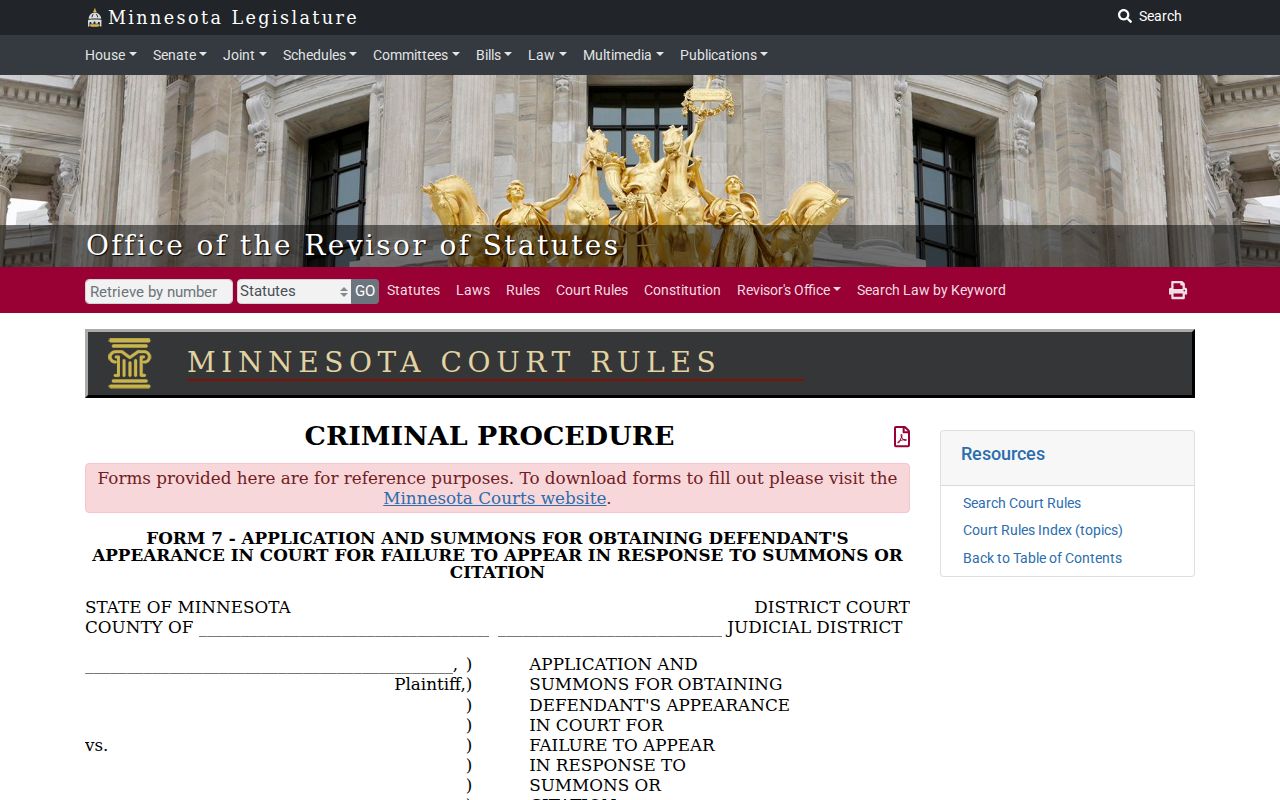
That warning is where the stakes first show up. The form tells a Mahnomen County reader that a missed court appearance can turn into a court order.
Minnesota Forms 7 and 8 Explained
Mahnomen County bench warrant files lean on two state forms, and each does a different job. Form 7 is the summons side. It tells a person to appear and warns what a missed date can cost. Form 8 handles the aftermath. This is the application and warrant a prosecutor files after a failure to appear on a summons or citation. A judge reviews it. If the judge approves, an officer is directed to bring the defendant back before the court. The full title is a mouthful. Its practical meaning in Mahnomen County is short: a prosecutor asks, a judge approves, and an officer goes to get the person. The blank form sits in Minnesota's online court-rules library, where anyone can read the fields and the instructions the state's courts work from.
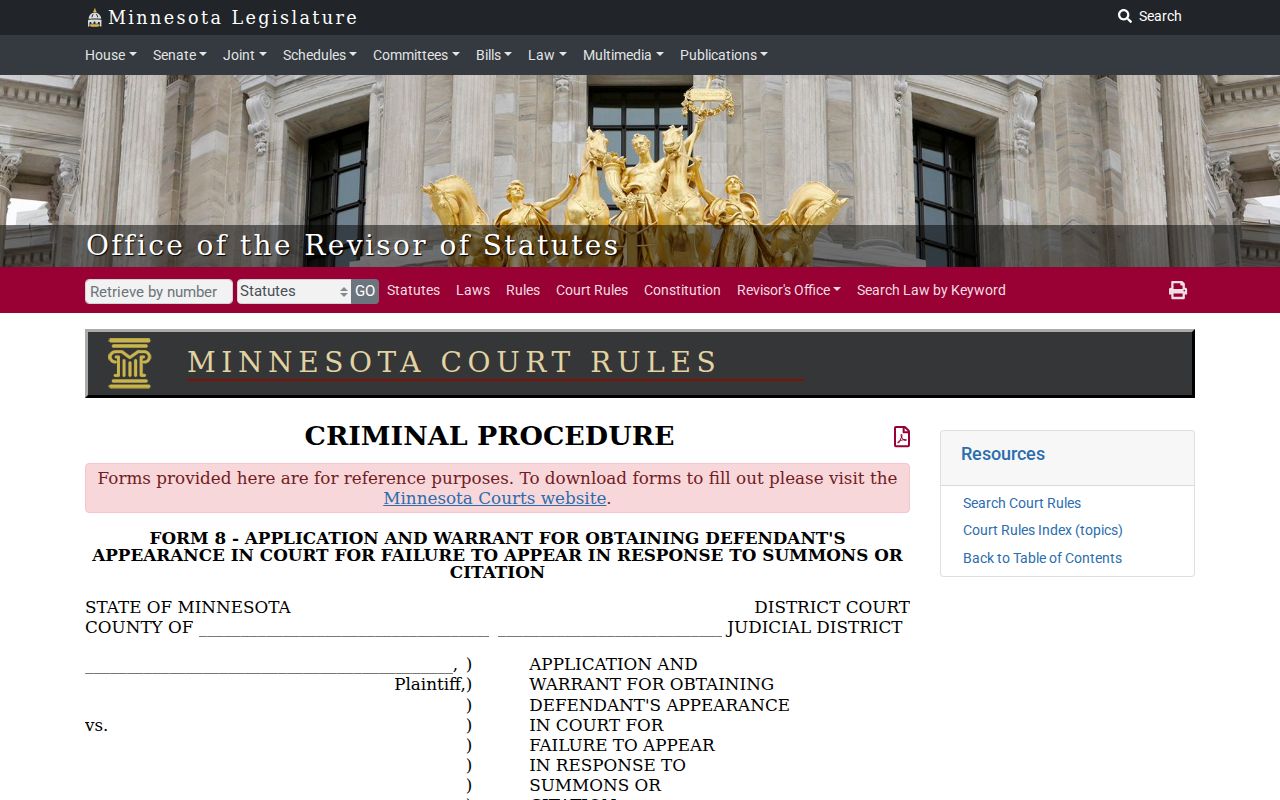
The form shows the fields a court works from. In Mahnomen County, that is why having a file number or citation number speeds up the call.
Bench Warrant Issuance in Mahnomen County
In Mahnomen County, issuance runs through the court. A prosecutor drafts the application. A judicial officer decides if the legal standard is met. When it is, the order goes to the sheriff or another authorized officer for execution. Mahnomen County District Court is the trial court for every criminal, traffic, and ordinance case filed in the county. There is no separate municipal court. A city citation becomes a district court case like any other. The warrant itself directs an officer to bring the person promptly. That wording follows a general rule. The rule requires producing a defendant before a judge as soon as one is available. That is form language. It is no local promise about timing or release. Note: a clerk can explain procedure and read a status, but only a judge or an authorized process can cancel a warrant.
No Mahnomen Bench-Warrant Walk-In Form or Fee
Most people expect a form, a fee, and a counter. Mahnomen County publishes none of those for bench warrants. There is no recall form, no posted surrender hours, no bond desk schedule, and no local warrant-recall fee. The gap is not a dead end. The first move is a call to Court Administration, where staff can say what the court expects: a scheduled appearance, a motion from an attorney, a payment where the law allows one, or a surrender with instructions. Minnesota posts a statewide district court fee list. A certified copy costs money. An uncertified printout does not. No Mahnomen-specific recall fee appears there, so ask before assuming any charge.
How Bench and Arrest Warrants Differ
People use the two terms interchangeably. A Mahnomen County bench warrant follows a missed court obligation. An arrest warrant follows probable cause of an offense, and the difference matters when choosing what to do.
| Point | Bench Warrant | Arrest Warrant |
|---|---|---|
| What starts it | A missed appearance or an unmet court obligation | Probable cause of an offense, shown by complaint or affidavit |
| Who asks | A prosecutor or the court, on a failure-to-appear or violation application | A prosecutor or law enforcement, on a probable-cause showing |
| Arrest authority | Usually yes, except in the sign-and-release category | Yes, unless the order says otherwise |
| Bail | Set by the court if the category allows it | Set by the court on the underlying charge |
| Underlying case | A case already open in court | A new or pending charge |
Mahnomen County Bench Warrant Surrender Rule
A rumor makes the rounds in Mahnomen County now and then. It says a person who surrenders within two days gets a warrant wiped out. The statute is far narrower than that. Minn. Stat. §609.49 deals with intentional failure to appear and with the obligations that come with release from custody. Tucked inside it is one limited provision. It concerns a felony charge only, and only when the person voluntarily surrenders within 48 hours of the required appearance. Conditions still apply. This is not blanket amnesty, it does not reach every offense category, and it promises no release. Gross-misdemeanor and misdemeanor cases follow different rules, though a fact-specific defense exists when circumstances beyond the person's control caused the absence. Anyone facing a Mahnomen County bench warrant should ask a lawyer whether the rule fits, since timing, offense level, and the reason for a missed court date all change the answer.
Clearing a Bench Warrant in Mahnomen County
Clearing the order is a court process. In Mahnomen County, work the steps in order and keep every written confirmation along the way.
- Find the case or citation number on the paperwork you already have.
- Call Court Administration at 218-935-2251 and ask whether a warrant is active and which category it falls under.
- Search the state case system by case or citation number for the public case status.
- Ask whether the court will set a new appearance date or expects a motion, a payment, or a surrender.
- If a surrender is required, confirm the building, the time, and where the person would be taken before traveling.
- Get written confirmation once the court acts, and recheck the status after a few days.
Caution: Paying a fine does not always recall a bench warrant. Ask the court whether a separate court action is required before you treat a payment as the end of it.
Release-Condition Warrants Use Their Own Application
Mahnomen County callers sometimes lump every court order together as a bench warrant. A release-condition warrant is its own thing. It claims probable cause that a person broke a condition of release. The paperwork differs too. Minnesota Form 10 is the application for a warrant after an alleged release-condition violation, and the rule page displays the form itself. A judicial officer reviews it. The form lays out the authority to arrest someone and bring them before the court. Bail and release terms rest on the judge's order. Because this warrant and a failure-to-appear warrant travel on different forms, a Mahnomen County defendant may face different next steps for each.
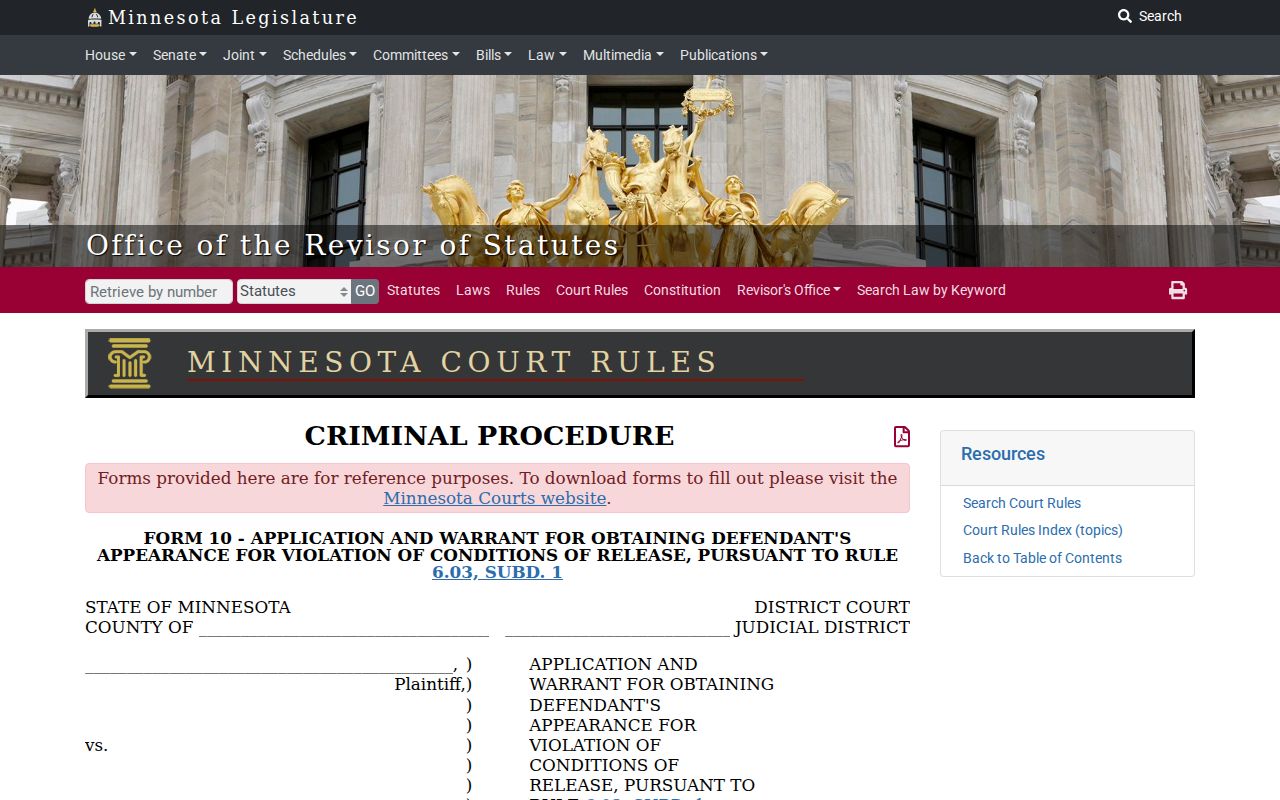
Mahnomen County readers should settle the form question first.
Mahnomen County Courts That Issue Bench Warrants
Every bench warrant here comes from one trial court. Mahnomen County District Court is that court. Sitting in the Ninth Judicial District, it holds original jurisdiction over criminal, traffic, civil, family, probate, and juvenile cases. That structure kills a common confusion. There is no city court to call and no justice-of-the-peace court to visit. The district court file is the file. Two neighboring systems stay separate. The White Earth Reservation Tribal Court keeps its own jurisdiction and records, while the federal District of Minnesota runs its own docket. For structure and leadership, see Mahnomen County District Court, and bring the file number when you call.
Serving Mahnomen County Bench Warrants Without Jail
Mahnomen County has no jail. Official state reports say so twice. Both the Minnesota House and the Department of Corrections regional jail study describe the county that way, so a person told to report has no local lockup to drive to.
The Mahnomen County sheriff's office handles intake, transport, and the current detention destination. Planning papers describe a regional bed contract. There is no local booking facility in that plan, so confirm the destination before anyone travels. None of this touches the order's legal force, only the logistics.